

Many casinos across the country are experiencing firsthand the limitations of conventional casino bus programs. These legacy models, often built around rigid schedules and mandatory 4-to-5-hour stay requirements, are not only outdated and inefficient – they actively repel more customers than they attract. They drain resources, restrict growth, and prevent casinos from reaching their true market potential.
Let’s break down the core issues:
💸 It Costs Too Much
In the traditional model, the casino pays the bus operator. The operator brings players, and the casino hopes those players lose enough money to offset the transportation cost and generate gaming profit.
This is not a business model, it’s a gamble.
If a bus underperforms or passengers have a winning day, the casino absorbs a direct expense with no offsetting revenue. The more buses you run under this model, the greater your financial exposure. Profitability hinges entirely on player losses, making it a volatile and unsustainable strategy.
Our program separates transportation from gaming risk. Even if players win, the casino can still generate profit from the bus operation itself, eliminating the “double loss” scenario.
🚫 It Limits the Number of Passengers
This flaw is even more damaging than the financial risk.
Most traditional programs operate on fixed schedules – one or two pickups per day. A typical bus might leave a city at 8:00 AM, arrive at the casino by 9:00 AM, wait until 1:00 PM, and return by 2:00 PM. This rigid timetable excludes a massive portion of your potential audience.
Inflexible Schedules – Many guests simply can’t commit to early departures or long mandatory stays. Parents with childcare duties, individuals with medical appointments, shift workers, and those relying on public transit are all left out.
Missed Opportunities – Even if a bus brings 30 or 50 passengers, the casino may be missing out on hundreds and even thousands of additional visitors daily. These are people who would come if given more flexible options. That’s millions in lost potential revenue.
Our program is engineered to eliminate these limitations.
😒 It Lowers the Desire to Use the Service
Let’s say you decided to increase the bus frequency -hourly pickups, multiple departures per day. Even then, the core flaw remains: forced long stays and outdated vendor negotiation tactics.
Modern lifestyles demand flexibility.
Consider John. He finishes work at 5:00 PM, spends time with family, and puts his kids to bed by 8:00 PM. He wants to visit your casino for a couple of hours, enjoy a drink, play poker, and be home before midnight. But under the traditional model, the 9:00 PM bus requires a 4-to-5-hour stay. John stays home.
Consider Jane. She has morning obligations and can’t take the 8:00 AM bus—the only one running that day. She’s excluded entirely.
Multiply John and Jane by tens of thousands. These are real, reachable customers who are blocked by outdated transportation design.
Our program reverses this trend, making casino visits more convenient, increasing ridership, and turning transportation into a strategic marketing tool.
📉 A Marketing Nightmare
Here is an actual bus schedule from another casino. The bus company name, phone number, and casino name are hidden to protect their privacy.
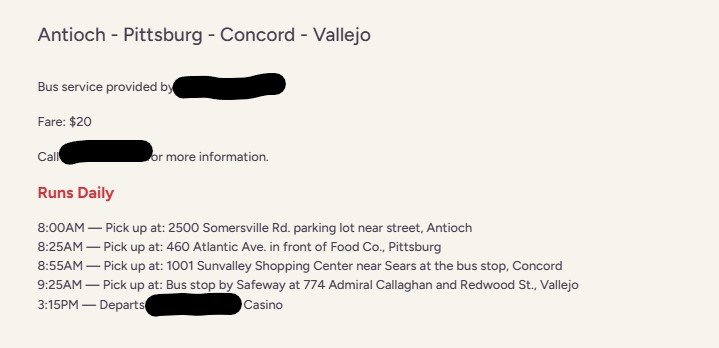
The bus company serves four cities with a combined population of over 440,000. The casino is just 60 miles away. Yet the operator runs a single 55-passenger bus once a day, and struggles to fill the seats.
What do you think? Is this a transportation problem? Or it’s a marketing failure? Our answer is: Both! The transportation guy failed to advise the casino on bus passenger Do’s and Don’ts, but then why would he? The casino is paying the bus monthly payments while the bus is parked in the casino’s parking lot. And the marketing department failed to see the problem with parked buses, and only 20 to 50 people out of 440,000. If you still don’t see the problem, please hire experts now – you are losing millions of dollars every year.
With the right system, the casino should be drawing 15 to 20 fully booked buses per day from similar markets. Our program makes that possible by using data-driven route design, optimized scheduling, and strategic alignment with your marketing team.
⚠️ The Hidden Pitfalls of Traditional Approaches
Most casinos replicate the same flawed bus model without questioning its design. Vendors benefit from the status quo. Casinos absorb the risk.
Our program changes that.
We create a “house edge” for your transportation strategy, giving players a reason to choose your service, and giving operators a reason to prioritize your property over competitors.
Our system fills these gaps. We provide the blueprint, the experience, marketing strategy, proprietary financial strategy, the route optimization methodology, vendor negotiation frameworks, and so much more. These are not disclosed publicly and are exclusive to our clients.
This isn’t about buses driving up and down the highway. It’s about building a scalable, self-funded system that protects your brand, expands your reach, and unlocks your market potential.